The Nostalgia Economy: Are We Running Back to the Past Because the Future Has Started to Frighten Us?
Something quiet but significant is happening in consumer culture.
People are buying vinyl records again. Not just older generations reconnecting with something they lost, Gen Z, who grew up entirely in the streaming era, are the ones driving significant portions of the resurgence.
Cassette tapes, a format most people assumed was dead and buried, have seen an eightfold increase in sales over the past decade in the United States alone.
DVD rental shops are reopening .
Independent bookshops are multiplying. Physical media, in almost every category, is quietly staging a comeback that the mainstream cultural conversation hasn't fully reckoned with.
The easy explanation is nostalgia. And nostalgia is part of it. But I think if we stop there, we miss something more interesting, more urgent, and more telling about where we actually are as a culture right now.
We Have Always Cycled Back
Before we get to AI and anxiety and the state of the world, it's worth acknowledging something that fashion historians and cultural theorists have documented for decades: we cycle. Always have.
The rough rule of thumb is a twenty to thirty year loop. Trends, aesthetics, and cultural touchstones from a previous generation become interesting again to the generation that didn't live them the first time, experienced through the filter of their parents' attics, charity shops, and the mythology that time builds around any era.
The nineties became cool again in the 2010s. The seventies came back in the nineties. The eighties are perpetually being rediscovered by someone.
Fashion moves in the most obvious cycles; silhouettes, colour palettes, denim cuts, heel heights. But the same pattern plays out in music, interior design, film aesthetics, and the technology we choose to surround ourselves with.
There is nothing inherently alarming about this. It's one of the ways culture breathes, exhales what it has processed, and reaches back for things that got left behind.
By that logic, the return of physical media makes complete sense on a purely cyclical basis. The generation currently in their late teens and twenties is reaching the age at which they're forming their adult cultural identity, and the era that sits twenty to thirty years behind them; the nineties and early 2000s, the golden age of the CD, the DVD, the Walkman, the video rental store; is right there, romantic with distance, available to be adopted as aesthetic and identity.
The cycle is doing exactly what the cycle does.
But I don't think the cycle fully explains it this time. Because the timing has collided with something else.
The Technology That Used to Feel Like Magic Now Feels Like a Threat
Cast your mind back to the feeling of the early internet.
The first time you downloaded a song. The first time you streamed a video. The first time you carried your entire music library in your pocket.
There was a quality to early consumer technology, even into the smartphone era, that felt genuinely wondrous. Innocent, almost.
The possibilities felt limitless in the best sense of the word. The worry hadn't arrived yet.
That feeling is gone now. And I think a significant number of people feel its absence, even if they can't name exactly what changed.
What changed is that the technology got consequential in ways that are genuinely frightening. AI platforms are in conversations with world governments about military applications. Autonomous systems are being considered for weapons targeting. Deepfakes are being used to destabilise elections and destroy reputations.
Entire creative professions are being disrupted faster than the social safety nets designed to catch people can respond. The same tools that generate a beautiful image or write a piece of music are entangled, structurally, with a much larger set of developments that carry real stakes and real darkness.
The thrill of new technology used to feel innocent. It no longer does. And that loss is significant.
Physical Media as a Kind of Refusal
When I look at the physical media resurgence through this lens, something shifts in how it reads.
Putting a record on, or a CD in the car, just for that moment, you forget about everything that's happening. There's a release in it. Something that the algorithm cannot provide, because the algorithm is part of what people are trying to release from.This is not naive. It's a coherent response to a real condition.
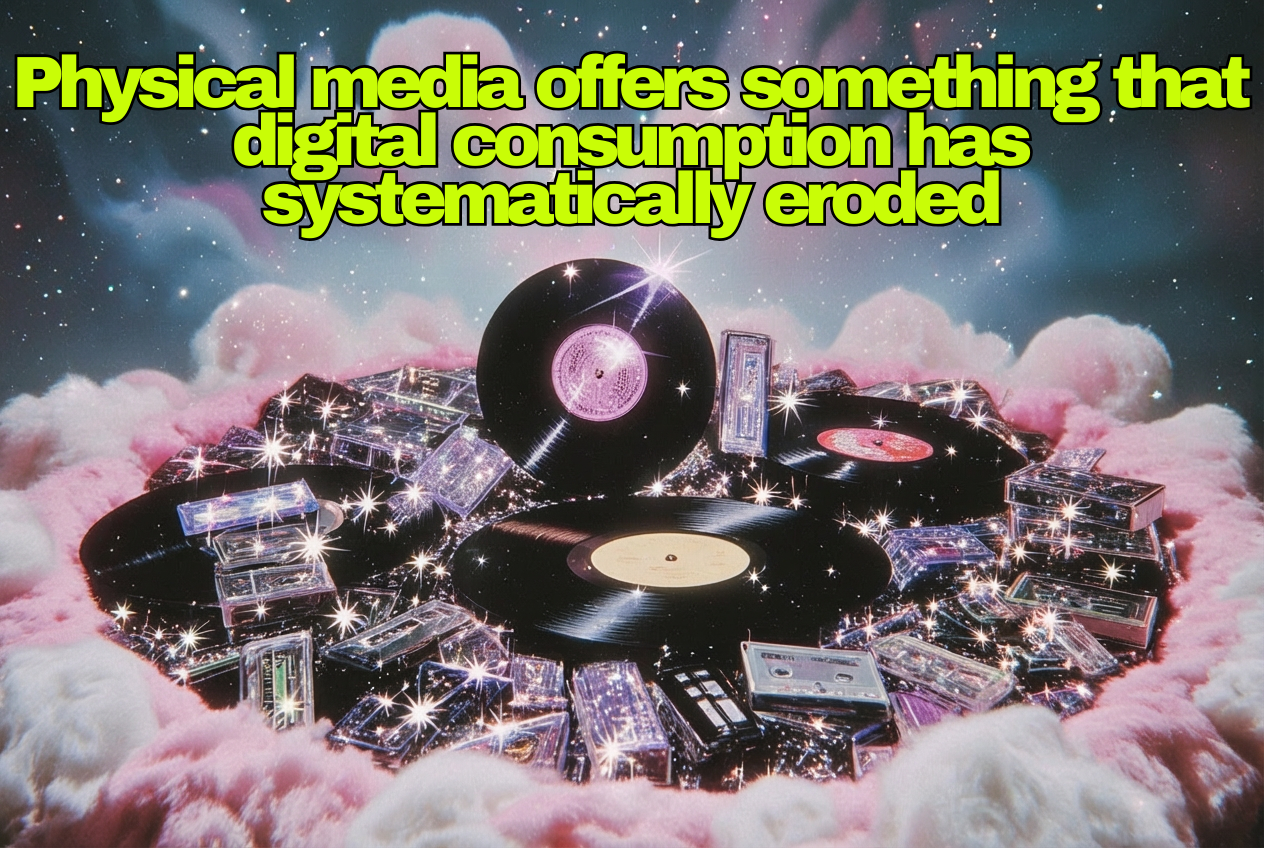
Physical media offers something that digital consumption has systematically eroded: ownership, permanence, and legibility. You can hold a record. You know exactly what it is, where it came from, and that it will still be there tomorrow regardless of what a licensing agreement or a corporate acquisition decides. Streaming services have spent the last decade demonstrating, repeatedly, that content you thought you had access to can simply disappear.
Amazon was sued over it. California passed legislation about it. People remember that films they loved vanished from platforms overnight, and they are responding rationally by buying the disc.But beyond the practical, there is the tactile.
The ritual. The act of browsing physical shelves in an actual shop, making a choice, taking something home, holding it.
These are experiences that engage the body, not just the screen. They happen in time and space rather than in the frictionless, context-free scroll. And increasingly, they feel like acts of quiet resistance against a culture of infinite access that has somehow managed to make people feel like they own less than ever before.
Is This About AI Specifically?
Here's the question I keep turning over: is the physical media resurgence a direct reaction to the rise of AI, or would it be happening anyway as part of the natural cultural cycle?
My honest answer is that it's both, and that the two forces have arrived at the same moment in a way that is amplifying each other.
The cultural cycle would have brought the nineties back regardless. That's just how the pattern works. But the particular intensity of the current retreat into tangible, legible, human-scaled things; the bookshops, the record stores, the video rental revival — feels like it carries an additional charge that the cycle alone doesn't fully account for.
AI has made the question of what is real, what is made by a human, what is authentic and what is generated, newly urgent in everyday life. Every image is now potentially synthetic. Every voice could be cloned. Every piece of writing might have emerged from a model rather than a mind. The ground that used to feel solid under concepts like "genuine" and "original" and "made by a person" has become uncertain.
Physical media is immune to this uncertainty in a way that digital content fundamentally isn't. A vinyl record was cut. A physical book was printed. A DVD was manufactured. These objects have a material provenance that can't be faked in the same way, and in a cultural moment where provenance and authenticity have become genuinely contested, that materiality carries a new kind of value.
The bookshop that offers human curation over algorithmic recommendation isn't just selling books. It's selling the reassurance that a person; with taste, with knowledge, with a point of view, made a choice about what deserves to be on these shelves. That's a specific thing that AI cannot replicate, and people are paying for it with their feet and their wallets.
The Aesthetic Counter reaction
There's a parallel movement happening in creative work itself that reflects the same impulse.
Film grain is back. Deliberately imperfect photography is ascendant. Lo-fi music production, with its tape hiss and room noise, commands serious cultural currency. There is a growing appetite for the evidence of human hands in the work; the mistake left in, the imperfection that signals a person was here, making decisions, in real time.
This is a direct counter reaction to AI's hyper-polish. The images that emerge from generation tools are technically flawless in a way that human production rarely is. And that flawlessness, once it becomes the baseline, starts to feel like a tell. Perfection reads as synthetic. Imperfection reads as real.
Which means that in a strange reversal, the "premium" product in certain creative contexts is now the one that shows its workings. The analog texture. The human error. The proof of presence.
Where This Leaves Us
I don't think the nostalgia economy is simply escapism, though it contains that element. I think it's a coherent cultural response to a set of real and legitimate anxieties about what technology is becoming, what authenticity means in an age of generative AI, and what we lose when everything is infinitely reproducible, infinitely accessible, and owned by nobody.
The cycle is real. The nineties were always coming back. But they're arriving with extra weight this time, because they represent something specific that people are consciously or unconsciously reaching for: a moment when technology felt like it was on our side, when the wonder of it was innocent, when you could put a disc in a player and the whole transaction was legible and yours.
That feeling isn't coming back. The technology has crossed too many thresholds. But the desire for it; for legibility, permanence, human scale, the evidence of craft and presence in the things we consume, that's not going anywhere either.
And perhaps the most interesting creative opportunity in all of this is for the people who can hold both things at once. Who work fluently with the new tools and understand deeply what the culture is hungry for. Who can make work that carries, somehow, the warmth and the weight of something real, even when the means of making it are entirely new.
The past isn't the answer. But it's pointing at something the present hasn't figured out how to give people yet.
That gap is where the most interesting work will happen.
